Executive Masterclass — Manila, 23–24 Nov 2026 · Future-Ready Leadership Executive Masterclass Webinar — 11 Nov 2026, APAC, EMEA & Americas
Reserve your place →Leading Human–AI Organizations Masterclass
Artificial intelligence is no longer simply another digital tool. It is becoming part of how organizations analyze, decide, coordinate, innovate and create value. The leadership challenge is therefore shifting from AI adoption to the design and leadership of Human–AI organizations.
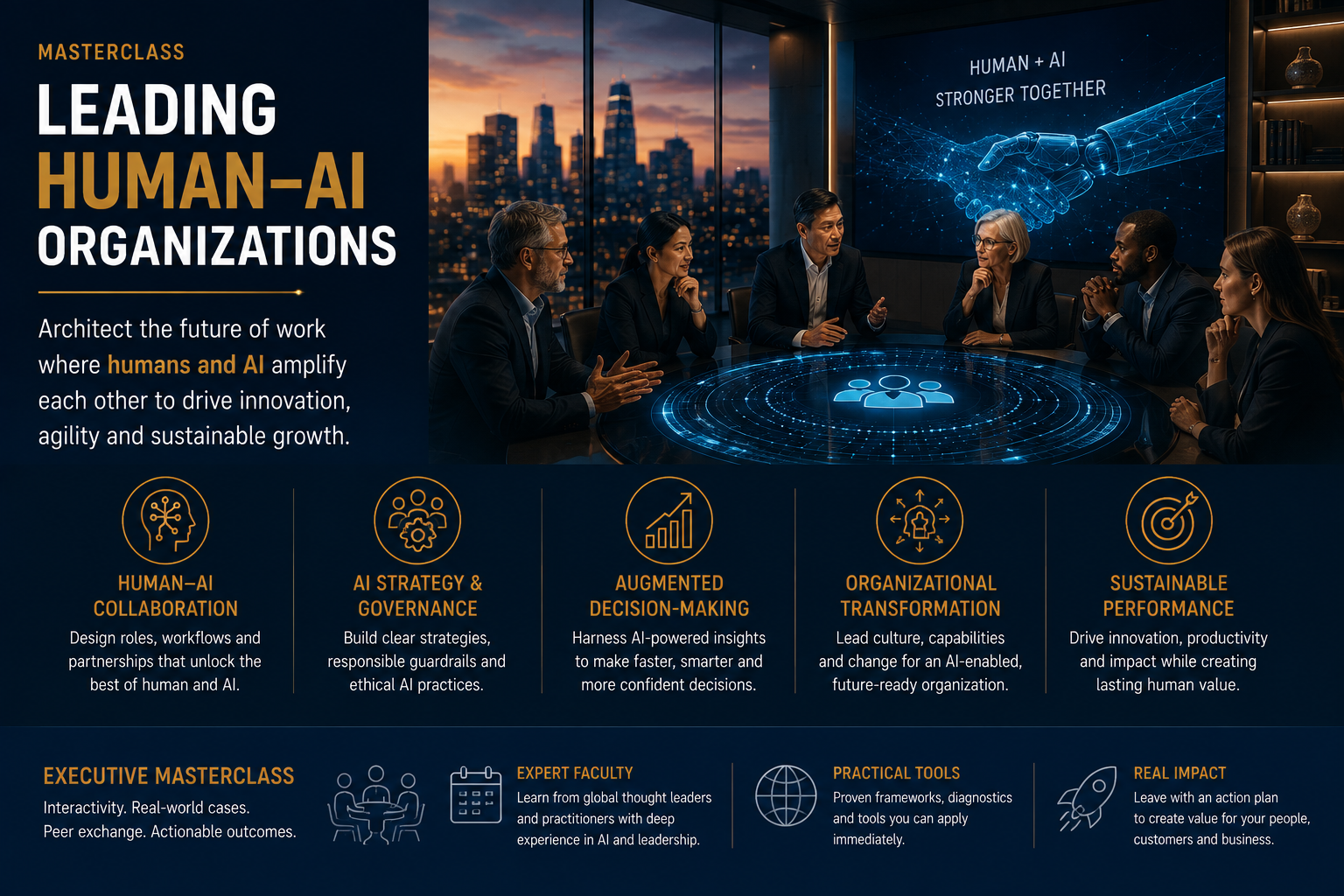
Applying the SHAPER AI Leadership™ Model
This executive masterclass equips Boards, CEOs and senior leaders with the strategic capabilities, governance mindset and organizational architecture required to combine human judgment with intelligent technologies responsibly. Using the SHAPER AI Leadership™ Model, participants learn how to anticipate disruption, harness Human–AI collaboration, architect adaptive organizations, protect trust through ethical AI governance, execute transformation with agility and renew leadership capability continuously.
- Masterclass
- Leading Human–AI Organizations Masterclass
- Descriptor
- Applying the SHAPER AI Leadership™ Model
- Primary Audience
- Boards, CEOs, C-suite executives, senior business leaders, CHROs, transformation leaders and enterprise leadership teams
- Core Proposition
- Lead the enterprise transition from AI adoption to responsible Human–AI collaboration and intelligent organizational transformation.
- Program Format
- 1-day executive masterclass; expandable to 2 days, board/CEO briefing, executive team workshop, or customized corporate journey
Why This Masterclass Matters Now
AI adoption has accelerated faster than many organizations' leadership systems, operating models and governance practices. The emerging challenge is no longer whether organizations will use AI, but whether leaders can redesign work, decision-making, accountability, culture and capability fast enough to create sustainable value from it.
- The 2026 Stanford AI Index reports that organizational AI adoption continued to rise, with 88% of surveyed organizations using AI and 70% using generative AI in at least one business function.
- Microsoft's 2026 Work Trend Index argues that the job of every leader is increasingly to rearchitect work around people, AI and agents; only about one in four AI users surveyed reported clear and consistent leadership alignment on AI.
- The World Economic Forum's Future of Jobs Report 2025 projects that nearly 40% of workers' core skills will change by 2030, while analytical thinking, resilience, leadership, collaboration and other human capabilities remain critical.
- The strategic differentiator is therefore not access to AI alone. It is the leadership capacity to combine machine intelligence with human judgment, purpose, trust, ethics and accountability.
The masterclass responds to this leadership readiness gap by treating AI-enabled transformation as a leadership, governance, workforce and organizational redesign challenge—not merely a technology implementation project.
The Leadership Challenge
Traditional leadership systems were designed primarily for organizations in which human beings held most of the information, exercised most of the judgment and performed most of the work. AI changes those assumptions. Executives increasingly lead environments where intelligent systems contribute to analysis, recommendations, workflow coordination, content generation, prediction, monitoring and decision support.
Leadership responsibility does not disappear as AI capability expands. It becomes more consequential. Leaders must determine purpose, define acceptable risk, preserve human accountability, govern algorithmic decisions, redesign roles, build workforce trust and ensure that AI augments rather than diminishes human potential.
Core Leadership Proposition
The organizations that will thrive in the Human–AI era will not necessarily be those with the most advanced technology. They will be those with the most adaptive leadership systems.
The program therefore reframes AI leadership around three fundamental shifts:
- From AI adoption to Human–AI collaboration.
- From technology implementation to organizational and leadership redesign.
- From isolated AI governance to enterprise trust, accountability and responsible stewardship.
The SHAPER AI Leadership™ Model
The SHAPER AI Leadership™ Model is the central capability architecture for the masterclass. It defines six mutually reinforcing leadership capabilities required to lead Human–AI organizations.
| SHAPER Capability | Executive Application |
|---|---|
| S – Strategic Foresight | Anticipate emerging technologies, geopolitical shifts, stakeholder expectations, strategic inflection points and long-term risks before they become urgent. |
| H – Harness Human–AI Collaboration | Integrate human judgment, creativity, empathy and ethical reasoning with AI-generated insight, automation and analytical capability. |
| A – Architect Adaptive Organizations | Redesign structures, operating models, roles, governance, workforce capability and culture for continuous change and intelligent work. |
| P – Protect Trust through Ethical AI Governance | Ensure transparency, accountability, responsible AI deployment, cybersecurity, human oversight and stakeholder confidence. |
| E – Execute Transformation with Agility | Translate strategic intent into disciplined transformation through adaptive leadership, experimentation, learning and rapid execution. |
| R – Renew Leadership Capability Continuously | Build lifelong learning, executive renewal, succession, coaching and organizational capability so leadership evolves with technology and disruption. |
Integration with the Integrated Future-Ready Leadership System™
SHAPER is taught as part of a broader integrated leadership system rather than as an isolated competency model:
- Leadership in Turbulence™ explains the external environment and the need to Anticipate, Navigate, Transform, Build Resilience and Renew.
- SHAPER AI Leadership™ Model defines the strategic capabilities required to lead Human–AI organizations.
- ELEVATE Cognitive Readiness™ Framework strengthens executive judgment, critical thinking, systems thinking, decision agility and cognitive resilience.
- Break. Build. Boldly Transform.™ provides the behavioral and coaching methodology for sustained leadership and organizational transformation.
Learning Outcomes
By the end of the masterclass, participants will be able to:
- Explain how AI changes leadership accountability, organizational intelligence, workforce design and governance.
- Assess where their organization sits on the journey from digitally enabled enterprise to AI-augmented Human–AI organization.
- Apply the six SHAPER capabilities to a real strategic or organizational challenge.
- Define where human judgment must remain central and where AI can appropriately augment or automate work.
- Identify organizational barriers to Human–AI collaboration, including legacy structures, capability gaps, culture, incentives and trust.
- Strengthen executive oversight of responsible AI, transparency, human accountability, cybersecurity and stakeholder trust.
- Redesign leadership and operating practices to support adaptive, resilient and learning-oriented organizations.
- Develop a 90-day leadership action agenda for advancing Human–AI organizational readiness.
Who Should Attend
- Board directors and board committee members
- CEOs, Presidents, Managing Directors and General Managers
- C-suite executives and enterprise leadership teams
- CHROs, Chief People Officers and leadership/talent leaders
- Chief Transformation, Strategy, Digital, Data, Technology and AI leaders
- Business unit heads and senior functional leaders
- Executives responsible for governance, risk, compliance, cybersecurity and responsible AI
- Senior leaders sponsoring major AI-enabled transformation programs
Masterclass Structure
The standard one-day format is designed as an executive working session rather than a technology lecture. Each module combines strategic input, facilitated dialogue, case-based discussion, reflection and application.
Module 1 – The New Leadership Reality
From digital transformation to intelligent transformation. How AI reshapes decision-making, organizational intelligence, work, accountability and leadership identity. The shift from AI tools to AI-enabled operating systems and Human–AI organizations.
Module 2 – Human–AI Collaboration and the New Leadership Contract
Understanding collaborative intelligence. Defining the complementary roles of people, copilots, agents and autonomous workflows. Determining where human judgment, empathy, creativity, context and accountability must remain decisive.
Module 3 – Applying the SHAPER AI Leadership™ Model
A guided application of the six SHAPER capabilities to enterprise strategy, workforce, culture, governance and transformation. Participants assess strengths, gaps and priority leadership actions.
Module 4 – Architecting Adaptive Human–AI Organizations
Redesigning work, roles, structures, decision rights, operating models and culture. Moving from static hierarchy toward adaptive systems capable of experimentation, cross-functional collaboration and continuous learning.
Module 5 – Protecting Trust through Ethical AI Governance
Board and executive accountability for responsible AI. Transparency, explainability, bias, privacy, cybersecurity, human oversight, acceptable risk, stakeholder trust and the relationship between governance and innovation.
Module 6 – Leading Workforce Reinvention and High-Trust Transformation
AI literacy, capability development, psychological safety, workforce anxiety, job redesign, reskilling and communication. Leading augmentation rather than allowing AI transformation to become a source of disengagement and mistrust.
Module 7 – Executing and Renewing the Human–AI Organization
Translating intent into action. Prioritizing use cases, aligning leadership, redesigning incentives, measuring progress, learning rapidly and continuously renewing leadership capability. Development of a 90-day executive action agenda.
Executive Application Exercises
- Human–AI Organization Readiness Scan: Identify where current leadership, governance, workforce and operating practices are enabling or constraining AI value.
- Human versus AI Decision Rights Map: Clarify which decisions can be automated, augmented, escalated or retained under direct human accountability.
- SHAPER Leadership Gap Assessment: Rate current leadership capability across the six SHAPER dimensions and identify priority gaps.
- Trust and Governance Challenge: Work through a realistic AI-enabled business scenario involving innovation, risk, bias, transparency and stakeholder expectations.
- 90-Day Action Agenda: Translate learning into a focused set of enterprise and personal leadership actions.
Illustrative Case Themes
Case material should be adapted by audience and industry. The following themes are recommended because they allow participants to examine both value creation and leadership/governance tensions:
- AI copilots and knowledge-work redesign
- AI-enabled customer and service transformation
- Adaptive operating models and organizational reinvention
- Responsible AI governance in regulated sectors
- Workforce reskilling and psychological safety during AI transformation
- Algorithmic decision-making, human oversight and accountability
- Enterprise resilience, cybersecurity and trust
- Board oversight of AI strategy and enterprise risk
Learning Methodology
The masterclass uses an executive-development methodology designed to move participants from insight to application.
- Research-backed executive input and thought leadership
- Facilitated boardroom-style dialogue
- Real-world business cases and ethical dilemmas
- Diagnostic self-assessment and organizational reflection
- Scenario planning and decision exercises
- Peer challenge and cross-functional discussion
- Action planning tied to participants' own strategic priorities
- Optional post-masterclass executive coaching or action-learning follow-through
Corporate Customization
For corporate clients, the masterclass can be tailored to the organization's strategy, AI maturity, industry, regulatory environment and leadership priorities. Customization may include:
- Industry-specific Human–AI use cases and scenarios
- Client strategy and transformation priorities
- Board and executive governance responsibilities
- Existing AI principles, policies and risk frameworks
- Leadership capability and succession priorities
- Culture, workforce and change-readiness challenges
- Company-specific action-learning challenge
- Executive team alignment or board/CEO working session
Delivery Options
| Format | Who Should Attend | Purpose |
|---|---|---|
| 90–120 minute Board/CEO Briefing | Boards and top executive teams | Strategic orientation, governance questions and leadership implications |
| 1-Day Executive Masterclass | C-suite and senior leaders | Core SHAPER architecture plus applied exercises and action plan |
| 2-Day Immersive Masterclass | Executive cohorts / transformation leaders | Deeper cases, simulations, diagnostics and enterprise application |
| Customized Corporate Journey | Leadership cohorts across the enterprise | Masterclass plus action learning, coaching, diagnostics and follow-through |
Organizational Outcomes
Organizations engaging this masterclass should expect the program to help strengthen:
- Leadership alignment on the purpose and strategic role of AI
- Executive confidence in leading Human–AI collaboration
- Clarity on decision rights, accountability and human oversight
- Responsible AI governance and stakeholder trust
- Adaptive organizational design and workforce readiness
- Cross-functional collaboration between business, people, technology and governance leaders
- Executive judgment when AI recommendations conflict with strategic, ethical or stakeholder considerations
- A practical transformation agenda linking AI capability with leadership and organizational readiness
Conclusion
Lead the Human–AI Organization—Before Technology Outpaces Leadership.
AI capability will continue to accelerate. The strategic question is whether leadership capability, governance, workforce readiness and organizational design will evolve fast enough to match it.
CEE works with Boards, CEOs and executive teams to translate the SHAPER AI Leadership™ Model into practical leadership capability and organizational action. The masterclass can be delivered as an open program, corporate masterclass, board/CEO briefing or customized executive development journey.
Enquire about a customized Leading Human–AI Organizations Masterclass for your organization.
Research and Intellectual Foundations
CEE/DLI Proprietary Foundations
- Sattar Bawany (2026). Future-Ready Leadership: Preparing Leaders for Disruption, Crisis, and AI-Accelerated Change.
- Sattar Bawany (2025). The Making of a C.R.I.S.I.S. Leader.
- Sattar Bawany (2023). Leadership in Disruptive Times: Negotiating the New Balance.
- Sattar Bawany (2019). Transforming the Next Generation Leaders: Developing Future Leaders for a Disruptive, Digital-Driven Era of the Fourth Industrial Revolution (Industry 4.0).
- SHAPER AI Leadership™ Model.
- Leadership in Turbulence™ Framework.
- ELEVATE Cognitive Readiness™ Framework.
- Break. Build. Boldly Transform.™ Framework.
Contemporary External Research Context
- Microsoft. (2026). 2026 Work Trend Index Annual Report: Agents, human agency, and the opportunity for every organization.
- Stanford Institute for Human-Centered Artificial Intelligence. (2026). The 2026 AI Index Report.
- World Economic Forum. (2025). Future of Jobs Report 2025.
Request the program outline
Ready to explore a partnership?
Speak with a CEE advisor about your leadership transformation agenda.