Executive Masterclass — Manila, 23–24 Nov 2026 · Future-Ready Leadership Executive Masterclass Webinar — 11 Nov 2026, APAC, EMEA & Americas
Reserve your place →Critical Thinking & Executive Judgment Masterclass
Artificial intelligence can generate answers in seconds. Critical thinking determines whether those answers deserve our confidence.
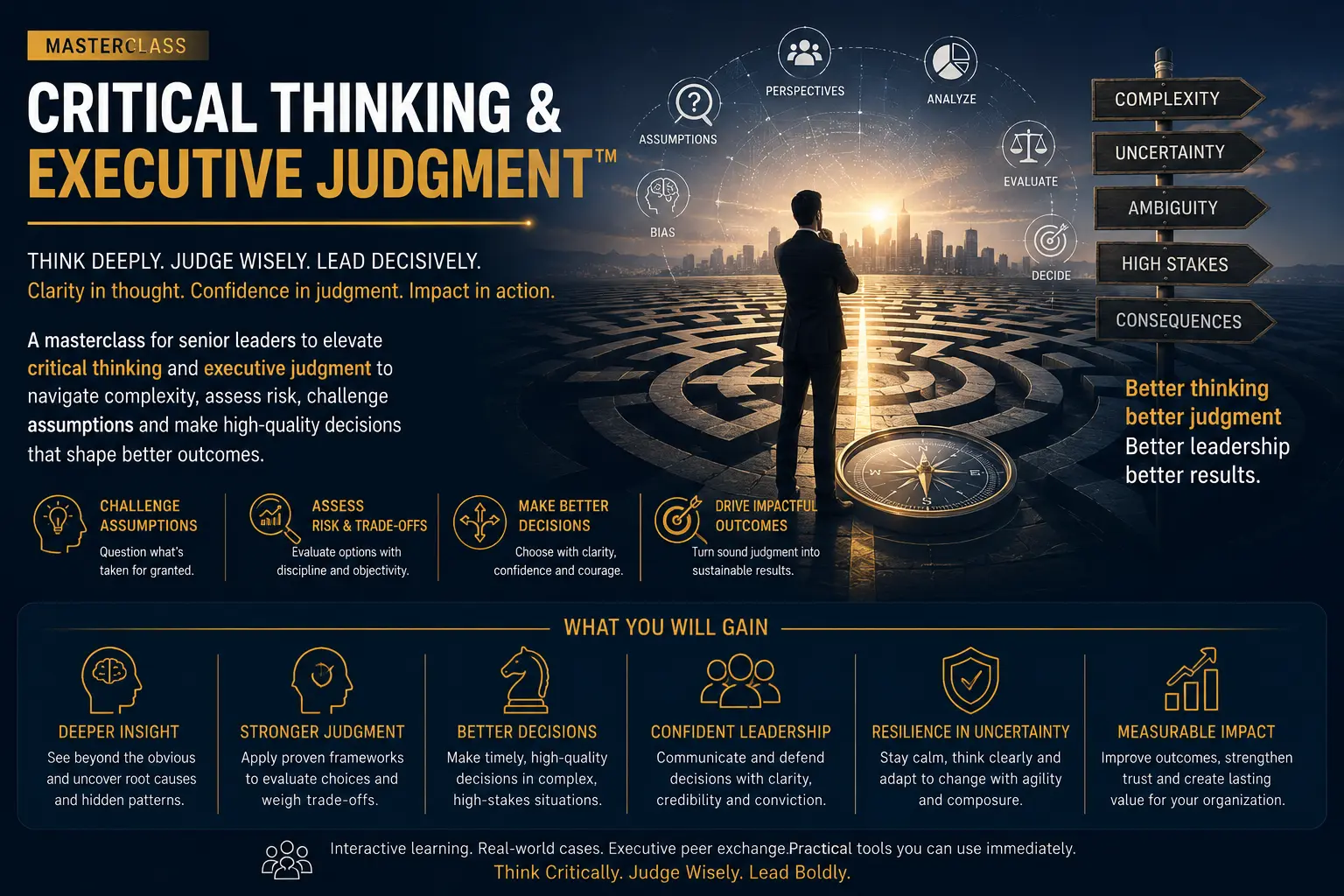
Making Better Decisions in an AI-Augmented World
This masterclass helps executives move from information consumption to disciplined judgment—challenging assumptions, evaluating evidence, recognizing cognitive and automation bias, understanding systemic consequences and making timely decisions when certainty is unavailable.
- Masterclass
- Critical Thinking & Executive Judgment Masterclass
- Descriptor
- Making Better Decisions in an AI-Augmented World
- Primary Audience
- Boards, CEOs, C-suite leaders, senior managers, strategy leaders and professionals responsible for high-stakes decisions
- Core Proposition
- Strengthen disciplined inquiry, evidence evaluation and executive judgment so leaders can use AI as decision support without surrendering human responsibility.
- Program Format
- 1-day or 2-day masterclass; executive decision lab; Board/leadership-team workshop
Why This Masterclass Matters Now
The executive challenge has shifted from information scarcity to information abundance. AI can summarize, model, predict and recommend faster than any leadership team—but analytical speed does not automatically produce wisdom.
Leaders remain responsible for purpose, values, acceptable risk, context, stakeholder consequences and final accountability. The quality of executive decisions therefore depends increasingly on the quality of executive thinking.
- AI-generated outputs may be plausible but incomplete, biased, context-poor or inaccurate.
- Confirmation, automation, anchoring, availability bias and groupthink can distort executive judgment.
- Boards increasingly oversee decisions influenced by AI and must ask disciplined questions about assumptions, evidence and human oversight.
- Critical thinking becomes an organizational capability when teams are psychologically safe enough to challenge prevailing views.
Executive Judgment Architecture
The program combines the practical RED Model with the newer ELEVATE Cognitive Readiness™ disciplines and Human–AI decision principles.
| Dimension | Executive Application |
|---|---|
| RECOGNIZE ASSUMPTIONS | Surface explicit and hidden assumptions, including those embedded in AI-generated analyses and legacy business models. |
| EVALUATE EVIDENCE & ARGUMENTS | Distinguish fact from opinion, test data quality, assess causal logic, compare perspectives and identify unsupported conclusions. |
| DRAW & TEST CONCLUSIONS | Reach evidence-based conclusions while considering uncertainty, alternative explanations and what would cause the decision to change. |
| SYSTEMS THINKING | Examine feedback loops, interdependencies, second- and third-order consequences, stakeholder effects and unintended outcomes. |
| DECISION AGILITY | Balance speed with quality; decide under uncertainty; set review triggers and adapt as new evidence emerges. |
| ETHICAL & CONTEXTUAL JUDGMENT | Integrate purpose, values, culture, political realities, stakeholder expectations and ethical implications that AI cannot determine independently. |
AI can recommend. Leaders must decide. AI can predict. Leaders must choose. AI can optimize. Leaders must determine what should be optimized—and why.
Learning Outcomes
By the end of the masterclass, participants will be able to:
- Apply a structured process for challenging assumptions and evaluating evidence.
- Distinguish AI-generated insight from reliable executive judgment.
- Recognize cognitive biases and automation bias before they distort strategic decisions.
- Ask better questions of data, experts, AI systems and leadership teams.
- Use systems thinking to anticipate unintended consequences and stakeholder impacts.
- Improve decision agility when information is incomplete.
- Create psychologically safe conditions for constructive challenge and cognitive diversity.
- Develop a repeatable executive decision-quality checklist for high-stakes decisions.
Who Should Attend
- Board directors and Board committee members
- CEOs and C-suite executives
- Senior leaders and business-unit heads
- Strategy, transformation, risk and investment leaders
- HR, talent and leadership-development leaders
- Professionals responsible for high-stakes analysis and decision support
- Executive coaches and facilitators supporting senior leadership teams
Masterclass Structure
The standard format is designed as an executive working session rather than a lecture. Each module combines strategic input, facilitated dialogue, case-based discussion, reflection and application.
Module 1 – Executive Thinking in the Age of AI
Information abundance, cognitive overload, AI decision support and why judgment becomes more—not less—important.
Module 2 – Recognizing Assumptions
Surfacing hidden assumptions, legacy mental models, AI prompts, framing effects and the beliefs embedded in strategic proposals.
Module 3 – Evaluating Evidence and Arguments
Evidence quality, fact versus opinion, correlation versus causation, alternative explanations, data limitations and credibility.
Module 4 – Cognitive Bias and Automation Bias
Confirmation, anchoring, availability, overconfidence, groupthink and the tendency to over-trust sophisticated technology.
Module 5 – Systems Thinking and Consequence Mapping
Interdependencies, feedback loops, stakeholder implications, unintended consequences and second-/third-order effects.
Module 6 – Decision Agility Under Uncertainty
Balancing speed and rigor, decision thresholds, reversible versus irreversible decisions, review triggers and adaptive execution.
Module 7 – Human–AI Executive Judgment Lab
Use AI to generate options and challenge thinking while preserving human accountability, context, ethics and purpose.
Executive Application Exercises
- Assumption Audit: identify explicit, implicit and AI-generated assumptions in a strategic proposal.
- Evidence Quality Matrix: classify evidence by relevance, reliability, completeness and bias risk.
- Bias Challenge Drill: identify confirmation, anchoring, automation and groupthink risks in a leadership case.
- Systems Consequence Map: ask 'What else changes because of this decision?'
- Human–AI Decision Lab: compare an AI-generated recommendation with an executive judgment process.
- Executive Decision Checklist and personal action plan.
Illustrative Case / Discussion Themes
- AI-assisted recruitment or talent decisions involving bias and explainability
- Strategic investment with conflicting forecasts
- Product or market-entry decision with incomplete evidence
- Board decision based on AI-generated scenario analysis
- Transformation program where groupthink or legacy assumptions threaten outcomes
Learning Methodology
- Master Coach-led executive input grounded in CEE/DLI research and proprietary frameworks
- Boardroom-style facilitated dialogue and peer challenge
- Case study analysis and scenario-based discussion
- Self-assessment, reflection and diagnostic exercises
- Practical tools, checklists and decision frameworks
- Action planning connected to participants' own organizational priorities
- Optional post-masterclass coaching, action learning or executive-team follow-through
Corporate Customization
The masterclass can use the client's real strategic decisions and decision-governance processes as application material.
- Client strategic proposals and investment cases
- Board/Executive Committee decision processes
- AI tools currently used for analysis and decision support
- Industry-specific ethical and regulatory dilemmas
- Decision-quality diagnostics and retrospective reviews
- Custom executive judgment simulations
Delivery Options
| Format | Who Should Attend | Purpose |
|---|---|---|
| 90–120 minute Board/CEO Briefing | Boards and top executive teams | Strategic orientation and governance implications |
| 1-Day Executive Masterclass | C-suite and senior leaders | Core framework, cases, diagnostics and action plan |
| 2-Day Immersive Masterclass | Executive cohorts / leadership teams | Deeper simulations, tools, cases and organizational application |
| Customized Corporate Journey | Leadership cohorts across the enterprise | Masterclass plus diagnostics, action learning, coaching and follow-through |
Organizational Outcomes
- More disciplined executive inquiry
- Reduced risk of bias, groupthink and automation over-reliance
- Stronger evidence-based decision-making
- Better integration of AI insight with human judgment
- Greater cognitive diversity and constructive challenge
- Improved decision speed without sacrificing quality
- Clearer Board and executive accountability for AI-influenced decisions
Conclusion
Better Questions. Better Judgment. Better Decisions.
In the AI era, competitive advantage will not come from having access to more answers. It will come from leaders who know which questions to ask, which assumptions to challenge and which conclusions deserve action.
CEE helps executives strengthen the cognitive discipline required to convert information into insight, insight into judgment and judgment into responsible action.
Enquire about the Critical Thinking & Executive Judgment Masterclass for your leadership team.
Research and Intellectual Foundations
CEE/DLI Proprietary Foundations
- Sattar Bawany (2026). Future-Ready Leadership: Preparing Leaders for Disruption, Crisis, and AI-Accelerated Change.
- Sattar Bawany (2025). The Making of a C.R.I.S.I.S. Leader.
- Sattar Bawany (2023). Leadership in Disruptive Times: Negotiating the New Balance.
- Sattar Bawany (2019). Transforming the Next Generation Leaders: Developing Future Leaders for a Disruptive, Digital-Driven Era of the Fourth Industrial Revolution (Industry 4.0).
- ELEVATE Cognitive Readiness™ Framework – Evidence-Based Critical Thinking, Systems Thinking and Decision Agility.
- SHAPER AI Leadership™ Model – Human–AI Collaboration and Ethical AI Governance.
- RED Model of Critical Thinking as a practical legacy tool.
Contemporary External Research Context
- World Economic Forum. (2025). Future of Jobs Report 2025.
- Microsoft. (2026). Work Trend Index / research on AI, agents and the redesign of work.
- Stanford Institute for Human-Centered Artificial Intelligence. (2026). AI Index Report.
Request the program outline
Ready to explore a partnership?
Speak with a CEE advisor about your leadership transformation agenda.