Executive Masterclass — Manila, 23–24 Nov 2026 · Future-Ready Leadership Executive Masterclass Webinar — 11 Nov 2026, APAC, EMEA & Americas
Reserve your place →Crisis Leadership & Organizational Resilience Masterclass
Crises rarely arrive at a convenient time, with complete information or clear choices. When extraordinary events test an organization, leadership quality becomes visible immediately.
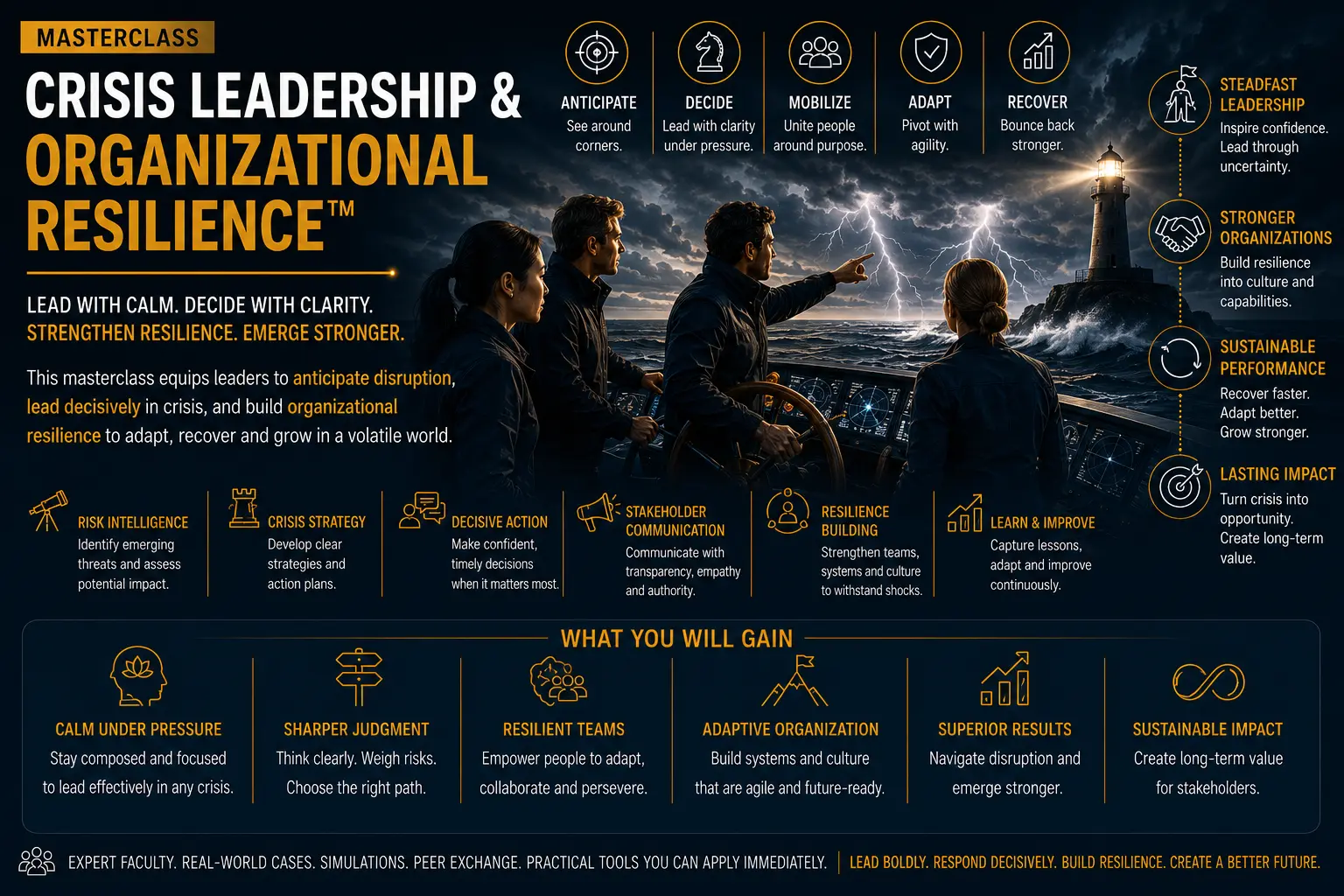
Leading Before, During and Beyond Crisis
This masterclass prepares Boards, CEOs and senior leaders to lead before, during and beyond crisis—combining strategic preparedness, rapid decision-making, stakeholder communication, cognitive resilience, governance and organizational renewal.
- Masterclass
- Crisis Leadership & Organizational Resilience Masterclass
- Descriptor
- Leading Before, During and Beyond Crisis
- Primary Audience
- Boards, CEOs, C-suite leaders, senior managers, risk/resilience leaders and crisis-management teams
- Core Proposition
- Build leadership readiness before crisis, exercise disciplined judgment during crisis, and strengthen organizational capability after crisis.
- Program Format
- 1-day or 2-day masterclass; crisis simulation; Board/CEO briefing; customized enterprise resilience program
Why This Masterclass Matters Now
In a VUCAD world, crises increasingly overlap with cyber risk, geopolitical instability, AI-enabled misinformation, supply-chain disruption, workforce anxiety and regulatory scrutiny. Crisis leadership can no longer be treated as a narrow emergency-management discipline.
Future-ready organizations prepare long before disruption escalates. They establish governance, decision rights, stakeholder protocols, crisis teams and resilience capability—and they use the post-crisis period to learn, adapt and emerge stronger.
- Crisis leadership requires speed without abandoning judgment.
- Boards and executives need clear decision rights, escalation protocols and stakeholder responsibilities before a crisis occurs.
- Reputation and trust can be damaged more by poor leadership communication than by the initiating event itself.
- Cognitive resilience is required to preserve clarity, ethical judgment and strategic perspective under sustained pressure.
- Organizational resilience is not only recovery; it is the ability to bounce forward through learning and renewal.
Future-Ready Crisis Leadership Architecture
The program integrates the crisis-leadership heritage of The Making of a C.R.I.S.I.S. Leader with the Leadership in Turbulence™ and ELEVATE™ frameworks.
| Dimension | Executive Application |
|---|---|
| PREPARE | Identify vulnerabilities, define governance, decision rights, crisis teams, scenarios, continuity arrangements and stakeholder protocols before crisis. |
| LEAD | Maintain presence, clarity, ethical discipline and decision quality when information is incomplete and pressure is intense. |
| COMMUNICATE | Preserve stakeholder confidence through timely, transparent, empathetic and coordinated communication. |
| RESPOND | Mobilize cross-functional teams, prioritize critical actions, use data/AI responsibly and adapt rapidly as facts change. |
| BUILD RESILIENCE | Protect people, operations, trust, cyber capability, supply chains and leadership capacity during prolonged disruption. |
| RENEW | Capture lessons, challenge failed assumptions, redesign systems and emerge stronger rather than simply restoring the previous state. |
Crisis leadership is not simply about surviving difficult circumstances. It is about creating an organization capable of becoming stronger because it has experienced adversity.
Learning Outcomes
By the end of the masterclass, participants will be able to:
- Clarify Board, CEO and executive responsibilities before and during crisis.
- Assess crisis readiness across governance, leadership, communication, teams, systems and stakeholder relationships.
- Make faster, higher-quality decisions when facts are incomplete or conflicting.
- Maintain cognitive resilience, emotional composure and ethical judgment under pressure.
- Design effective crisis-management structures, escalation paths and response playbooks.
- Strengthen crisis communication and stakeholder confidence.
- Build high-performance cross-functional crisis teams.
- Move from recovery toward organizational resilience, learning and bounce-forward renewal.
Who Should Attend
- Board members and Board risk/audit committee members
- CEOs and C-suite executives
- Senior managers who may lead or support a crisis response
- Enterprise risk, business continuity and resilience leaders
- Corporate affairs, communications, HR and legal leaders
- Cybersecurity, operations and supply-chain leaders
- Public-sector leaders and emergency/crisis-management executives
Masterclass Structure
The standard format is designed as an executive working session rather than a lecture. Each module combines strategic input, facilitated dialogue, case-based discussion, reflection and application.
Module 1 – The Anatomy of Modern Crisis
Crisis versus risk; systemic and overlapping crises; AI-enabled misinformation and cyber threats; reputational, operational and human consequences.
Module 2 – Governance, Preparedness and Crisis Architecture
Board/CEO responsibilities, crisis-management committees, command structure, decision rights, escalation protocols, continuity and contingency planning.
Module 3 – Executive Judgment Under Pressure
Cognitive overload, ambiguity, incomplete information, confirmation and automation bias, ethical dilemmas and decision agility.
Module 4 – Leading the Crisis Team
Cross-functional coordination, shared accountability, role clarity, psychological safety, rapid response and disciplined execution.
Module 5 – Stakeholder Trust and Crisis Communication
Transparent communication, empathy, stakeholder mapping, media/social-media dynamics, regulatory engagement and maintaining legitimacy.
Module 6 – Personal and Organizational Resilience
Cognitive resilience, leadership composure, operational/cyber/supply-chain resilience, continuity, learning and adaptive capacity.
Module 7 – Beyond Recovery: Bounce Forward
After-action review, institutional learning, redesigning weak systems, restoring trust, renewing leadership capability and converting crisis lessons into transformation.
Executive Application Exercises
- Crisis Readiness Scan: governance, decision rights, people, systems, communications and continuity.
- Executive Crisis Simulation: fast-moving scenario with incomplete information and competing stakeholder pressures.
- Crisis Decision Log: identify assumptions, evidence, trade-offs, decisions and triggers for reassessment.
- Stakeholder Communication Drill: develop a first-hour leadership message and stakeholder response map.
- Bounce-Forward Review: determine what should be restored, redesigned, stopped or strengthened after the crisis.
Illustrative Case / Discussion Themes
- Cyberattack / ransomware with operational and reputational consequences
- AI-generated misinformation or deepfake crisis
- Supply-chain or geopolitical disruption
- Product/service failure involving regulators and customers
- Public health, safety or workforce crisis
- Reputation crisis requiring Board and CEO visibility
Learning Methodology
- Master Coach-led executive input grounded in CEE/DLI research and proprietary frameworks
- Boardroom-style facilitated dialogue and peer challenge
- Case study analysis and scenario-based discussion
- Self-assessment, reflection and diagnostic exercises
- Practical tools, checklists and decision frameworks
- Action planning connected to participants' own organizational priorities
- Optional post-masterclass coaching, action learning or executive-team follow-through
Corporate Customization
Corporate versions can be aligned to the organization's actual risk profile and crisis-management arrangements.
- Client crisis-management plan and governance structure
- Industry-specific high-impact scenarios
- Board and CEO crisis responsibilities
- Communication and stakeholder protocols
- Cyber, operational, supply-chain and reputational resilience priorities
- Table-top simulation using client-specific facts
- Post-program after-action coaching and playbook refinement
Delivery Options
| Format | Who Should Attend | Purpose |
|---|---|---|
| 90–120 minute Board/CEO Briefing | Boards and top executive teams | Strategic orientation and governance implications |
| 1-Day Executive Masterclass | C-suite and senior leaders | Core framework, cases, diagnostics and action plan |
| 2-Day Immersive Masterclass | Executive cohorts / leadership teams | Deeper simulations, tools, cases and organizational application |
| Customized Corporate Journey | Leadership cohorts across the enterprise | Masterclass plus diagnostics, action learning, coaching and follow-through |
Organizational Outcomes
- Greater Board and executive crisis readiness
- Clearer governance and decision rights
- Faster, more disciplined decision-making under pressure
- Stronger cross-functional crisis coordination
- Improved stakeholder communication and trust
- Greater leadership and organizational resilience
- More effective post-crisis learning and renewal
Conclusion
Prepare Before the Crisis. Lead Through It. Emerge Stronger.
The best time to build crisis leadership capability is before the organization is tested.
CEE helps Boards, CEOs and senior teams strengthen preparedness, executive judgment, crisis response and resilience so that disruption becomes a source of learning and renewal rather than long-term fragility.
Enquire about a customized Crisis Leadership & Organizational Resilience Masterclass or executive crisis simulation.
Research and Intellectual Foundations
CEE/DLI Proprietary Foundations
- Sattar Bawany (2026). Future-Ready Leadership: Preparing Leaders for Disruption, Crisis, and AI-Accelerated Change.
- Sattar Bawany (2025). The Making of a C.R.I.S.I.S. Leader.
- Sattar Bawany (2023). Leadership in Disruptive Times: Negotiating the New Balance.
- Sattar Bawany (2019). Transforming the Next Generation Leaders: Developing Future Leaders for a Disruptive, Digital-Driven Era of the Fourth Industrial Revolution (Industry 4.0).
- Leadership in Turbulence™ Framework – Build Resilience imperative.
- ELEVATE Cognitive Readiness™ Framework – Cognitive Resilience / Endure with Clarity.
- SHAPER AI Leadership™ Model – Protect Trust, Execute Transformation and Renew.
Contemporary External Research Context
- World Economic Forum. (2025). Future of Jobs Report 2025.
- Microsoft. (2026). Work Trend Index / research on AI, agents and the redesign of work.
- Stanford Institute for Human-Centered Artificial Intelligence. (2026). AI Index Report.
Request the program outline
Ready to explore a partnership?
Speak with a CEE advisor about your leadership transformation agenda.